
Trace Seminole County Former Owners
Chasing Seminole County former owners works best backward, one deed at a time. Start with the most recent transfer you can find. Its grantee took title; its grantor gave it up. That same grantor was once a grantee. Pull the deed where he or she received the parcel. Work each transfer the same way, moving steadily into the past. Along the way, capture the land description, the subdivision or land lot, the recording date, the instrument type, and the book and page for every step. Those specifics matter. A stranger with a similar name may own a different Seminole County parcel entirely.
| Source | Years It Covers | Where Held | What It Shows |
|---|---|---|---|
| GSCCCA Real Estate Index | At least 1999 statewide; 1993-1998 data being added | Georgia Superior Court Clerks' Cooperative Authority | Parties, recording data, property location, instrument type, book/page |
| Seminole deed books and reverse indexes | County series after organization; exact oldest book needs confirmation | Superior Court Clerk | Earlier grantor-to-grantee transfers and deed text |
| Recorded subdivision plats | Book-specific; exact range not published | GSCCCA and Superior Court Clerk | Lot, block, roads, easements, and plat references |
| Archives, tax digests, and probate microfilm | Reel and collection dates vary | Georgia Archives and FamilySearch | Older ownership clues, estates, and annual tax context |
The GSCCCA Real Estate Index carries the modern stretches of the chain. Older links may not appear there. When the index runs dry, contact the Clerk of Superior Court instead of assuming the title history ends where the web results do. The Clerk can tell you whether the next leg lives in an office-only index, a deed book, or on microfilm. Tax digests and newspaper notices help fill gaps. Still, a name in those sources is only a clue, never a stand-in for the deed that actually conveyed the land.
Build a Seminole County Owner Timeline
Set up a simple working table before digging into the older books. Keep it to the single tract. Note exactly what each document says. Leave blanks where evidence is thin. The sample rows illustrate the method only, not real Seminole County transfers or people. A tax record alone should never fill a gap in the timeline. Its date or deed type does not prove a transfer.
| Transfer Date | Grantor to Grantee | Deed Type | Book/Page |
|---|---|---|---|
| Newest verified date | Prior owner to current grantee | As indexed | Exact reference |
| Next earlier date | Earlier grantor to prior owner | As indexed | Exact reference |
| Earlier book entry | Book parties in recorded order | Read from instrument | Volume and page |
Order the entries newest to oldest. Then compare land descriptions at each step. Watch for shifted acreage, a different lot, a corrective deed, or a tract suddenly added. Any of those can signal that the parcel chain split or merged, which calls for reading the instrument itself rather than forcing every name into one tidy line.
Seminole County Ownership Online
Georgia's statewide real estate index reaches back to at least the start of 1999 for every county. Older material from 1993 through 1998 is steadily being folded in. That timeline is the solid online baseline for tracing prior owners of record in Seminole County. It is not a promise of completeness. Older volumes, local index entries, and some images may still sit only in the clerk's office. They may not be on the web at all. The official real estate search is the entry point where the recorded chain begins. Start there, then work backward deed by deed.
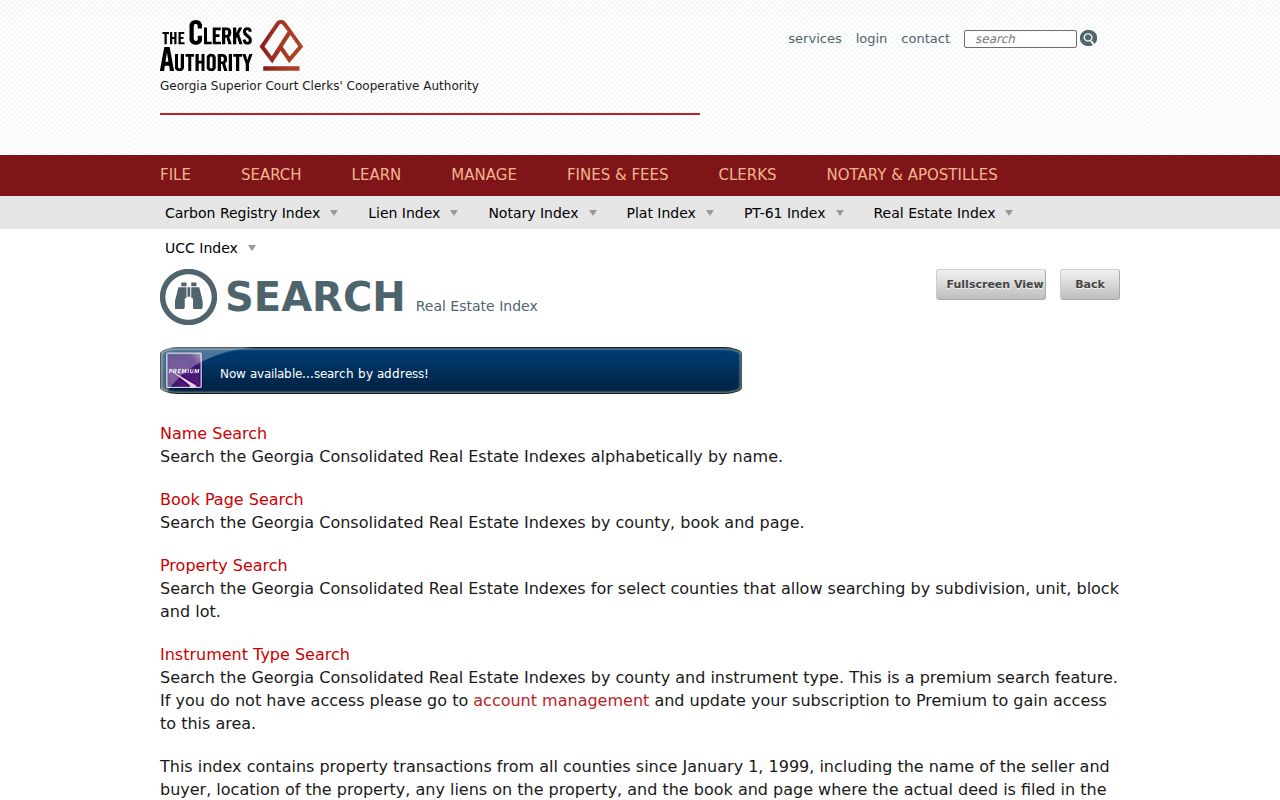
The search splits into a name path and a book-page path. That division helps a researcher jump from a party's name straight to the exact reference for the next link in the chain.
Time-depth limit. The online index reaches at least 1999 statewide; ask the Seminole County Clerk about earlier local books and microfilm.
Searching an index and viewing a document are separate steps. The index is one layer. The image is another. GSCCCA offers a regular account at $14.95 per calendar month for unlimited image viewing. It also charges $0.50 per printed page. A free index hit can still carry real value. It may reveal the book and page you need, even when the deed image itself requires an account, a request to the clerk, or a trip to the office.
Read Seminole County Deeds Backward
Reading a deed backward means following the roles. A grantee received an interest; a grantor gave one up. Begin with the current owner of record as a grantee, then open the likely instrument. Search that deed's grantor as your next earlier name. Keep the county, date range, instrument type, and property details tight, so a namesake cannot lead the chain astray.
- Find the newest deed in which the known owner appears as grantee. Confirm the property location and legal description.
- Record the grantor exactly as indexed, including initials, entity suffixes, trustee language, or estate roles.
- Search that grantor as an earlier grantee. Match the parcel facts and book/page rather than relying on the name alone.
- Repeat until the web index ends. Then carry the last verified party and legal description to the local books.
- Grantor
- The party conveying a stated property interest.
- Grantee
- The party receiving that interest.
- Chain of title
- The linked sequence of instruments affecting ownership of one tract.
- Reverse index
- An index arranged to help find a party in the grantee or grantor role.
- Warranty and quitclaim deed
- Different conveyance forms; neither label alone tells the whole ownership story.
Keep Seminole County Parcel Clues
Street addresses wear out fast in an old deed chain. Seminole County notices instead carry compact parcel identifiers like D 21 115 and 20A 6 8. The county publishes no numbering legend for these, so treat the string as opaque. Copy it exactly as written. Guessing a city, map district, or deed era from a prefix only invites error. A rural parcel demands more: keep the land lot, district, acreage, and the full metes-and-bounds call. A platted parcel needs its subdivision name, lot, block, and the plat book and page.
Old plat citations offer a useful anchor. Fairview Subdivision sits at Plat Book 1, page 5. Crestview appears at Plat Book 1, page 101. Riverview Subdivision No. II is recorded at Plat Book 4, page 160, and Reynolds Village Subdivision No. 2 at Plat Book 3, page 243. When you compare prior owners of record, a book and page key usually holds up better. A street name may have changed with time.
Note: A plat ties lots together, but it does not prove that each postal address lies within a city boundary.
Before Seminole County Existed
Seminole County was carved from Early and Decatur County land, with the split taking effect January 1, 1921. A courthouse came the next year. So a deed chain that reaches back before 1920 may run through a parent county instead of the earliest Seminole book. That is a jurisdiction shift, not a missing deed. Parcel research across that line simply changes shelves.
Start with the last solid pre-formation property description. Carry it into the Early and Decatur County deed indexes. Compare the land lot, district, acreage, adjoining owners, and any referenced plat. The Georgia Archives digital collection holds digitized microfilm of tax digests, deed books, and probate material. The right Seminole or parent-county reel still has to be confirmed, and the state cautions that many post-1900 county records sit elsewhere.
Seminole County Probate Owner Clues
An owner's death can break a clean chain of title. The last recorded deed may name someone who has since passed. After that, a different label can appear in later property records. An executor, administrator, heir, trustee, or life tenant may surface there. Seminole County Probate Court holds the estate and guardianship files. It also holds funds for missing heirs or minors. The court publishes no online estate docket. That leaves the counter, phone, mail, or a targeted request for an existing file. Those are the practical routes into Seminole County probate.
Run searches on several names. Try the decedent, the estate itself, the fiduciary, and any later grantee. A probate order can explain who had authority to sell. The recorded deed still proves the transfer of ownership. A local tax notice sample shows the same caution. It lists a FiFa defendant apart from the current owner of record. Copy each person's exact role rather than assuming everyone named held the same interest.
Seminole County Ownership History Sources
The Donalsonville News has published since 1916. Its archive often supplies names and dates when the deed records grow hard to read. Search by subdivision and legal terms, not just by owner. Useful local terms include Fairview, Crestview, Riverview, and Reynolds Village. Joy Homes, FiFa, notice of sale, and administrator appear as helpful terms too. A newspaper notice can point toward an estate. It may also point to a foreclosure, a reference deed, or a plat. Treat each one as a lead back to the underlying record.
The Seminole County Public Library sits at 103 W 4th Street. It keeps a genealogy department and can assist with local history. The library does not publish exact directory, obituary, or reverse-directory year ranges. Ask staff by year and collection instead of assuming a run exists. These sources can tie a historic address to a household or an estate. That helps when a modern Seminole County property search runs dry.
Reach Seminole County Ownership Records
Online access is one channel among several. The GSCCCA index covers deeds and plats. Older or certified material may still run through the Clerk. Earlene Bramlett's office sits at 200 S Knox Avenue, P.O. Box 672, Donalsonville. The phone is 229-524-2525, with published weekday hours of 8 a.m. to 5 p.m. Before sending payment, ask about your options. An office terminal, a local book, or a certified copy may be the right next step.
For records not indexed online, you have several routes. Request inspection in person, call, write by mail, or send a Georgia Open Records Act request. Name the parcel, the record type, and the date range. Georgia agencies generally must respond within three business days. Otherwise they must explain the timetable and estimated cost. The Clerk, the library, Georgia Archives, and FamilySearch form a fallback chain. Each one covers a gap when another source stops short. No universal mail form or complete fee schedule is posted, so ask the office directly.
Limits of Seminole County Owner History
How far a Seminole County former-owner search reaches depends on three things. The surviving index matters. The correct county for the date matters. A stable legal description matters most of all. No official source records a courthouse fire, flood, or destroyed-book event here. A missing web result is not lost history. Ask the Clerk about the oldest book. Ask also about the first scanned volume and any office-only bridge before concluding anything.
FamilySearch holds broad Georgia collections of wills, deeds, and probate material. Its exact Seminole County coverage has to be checked at the collection level. Tax digests show who was assessed in a given year. They do not prove a transfer by themselves. Directories and legal notices carry the same limit. Reconstruct former owners from corroborating documents. Then use the full deed chain for house history, estate work, or purchase diligence.
Lawful use. Former-owner records support house history, estate research, and property diligence. Never use them to track, target, or harass a living person.