
Seminole Property Tax Record Fields
Valuation and collection sit in two different offices within Seminole County property tax records. The Assessor sets value and administers exemptions. The Tax Commissioner issues the bill and collects payment. A recorded deed can clarify ownership, but it is never the tax statement itself.
| Field | What It Shows | Official Source |
|---|---|---|
| Fair-market value | The Assessor's January 1 estimate of full value. | Board of Tax Assessors |
| Assessed value | Forty percent of fair-market value before applicable deductions. | Board of Tax Assessors |
| Exemption | A qualified reduction applied to taxable assessed value. | Board of Tax Assessors |
| Tax year and bill | The account selected for billing and payment. | Tax Commissioner |
| Delinquency or FiFa | Unpaid-tax enforcement and recorded execution status. | Tax Commissioner and Superior Court Clerk |
A deed or transfer record may show the sale price. That figure is not assessed value, and neither number alone predicts what a property would sell for today.
Three Seminole Tax Record Roles
Three offices divide the work. The Board of Tax Assessors handles valuation, equalization, exemptions, returns, and the first appeal stage. The Tax Commissioner bills and collects taxes. It is led by Leslie Johnson. The office also runs the account search. The Board of Equalization takes disputes that survive assessor-level review.
The split matters for every request. Payment questions go to the Tax Commissioner at 200 S Knox Avenue, 229-524-2238. Value or exemption questions belong to the Assessor. Appeals can move from the Board of Equalization to Superior Court. Contesting the tax amount is not the same as contesting taxability, value, or uniformity.
Look Up Seminole Tax Bills
The Seminole tax-account portal accepts a Tax Year plus Name, Bill #, Company, Parcel, or Address. Owner-name mode adds Starts With and Contains options. The portal publishes no year list or archive depth, so note the year you select before comparing accounts.
- Choose the tax year tied to the statement or delinquency question.
- Select Address for a street lead, Parcel for the county key, Bill # for a statement, or Company for an entity.
- Copy the result's bill and parcel identifiers rather than relying on the name alone.
- Check the Assessor's qPublic link for value and exemptions when it is reachable.
- Call the Tax Commissioner if the result is blank, unclear, or appears to omit a prior year.
The controls appear in the official Seminole tax-account search.
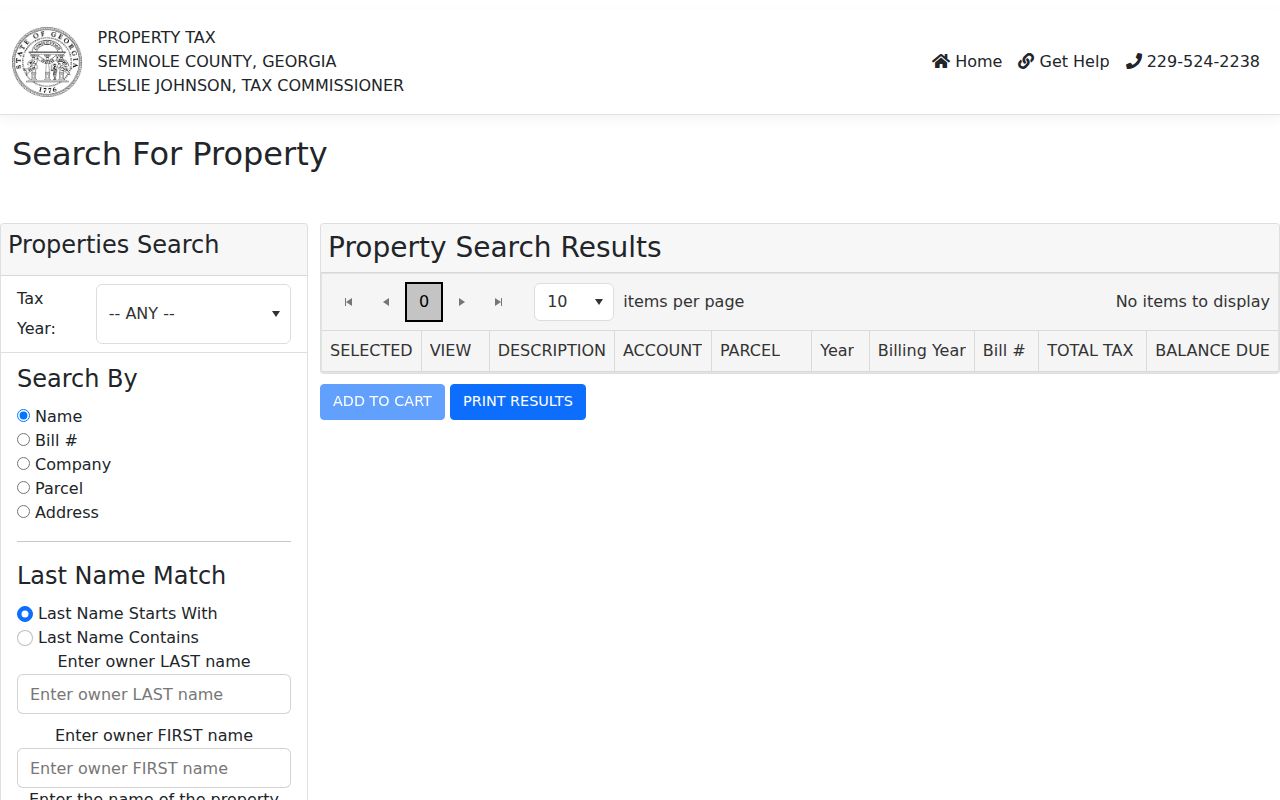
A tax year and a search mode come first.
Seminole Property Tax Search Modes
Each AssuranceGov search mode matches a different fact you already hold. Name and Company sit in separate fields, so a business never has to be squeezed into a surname box. Parcel and Bill # are the strongest keys. Use them whenever you have the number.
| Mode | Best Starting Fact | Limit to Check |
|---|---|---|
| Name | Owner last and first name | Starts-with or contains can broaden unrelated hits. |
| Company | Formal entity name | Use the exact suffix and spelling. |
| Bill # | Known tax statement | Confirm the selected tax year. |
| Parcel | Known map or parcel key | No local prefix guide was published. |
| Address | Known situs or street line | Postal and legal descriptions can differ. |
The portal offers Property Search Results and Print Results controls. It provides no full parcel card and no CSV export.
Read Seminole Assessed Values
The Tax Commissioner's valuation information states that fair-market value is set as of January 1 each year. Assessed value equals 40 percent of fair-market value. Applicable exemptions then reduce the taxable assessed amount used in the tax calculation.
The qPublic assessor page returned access denied during research. Therefore, exact local card labels, value-history fields, sale displays, sketches, and refresh timing cannot be promised. Retry the official link or ask the Assessor for the current and prior card. Compare the roll year with any deed recording date before assuming a recent transfer has reached the tax account.
- Fair-market value
- The Assessor's estimate of full property value as of the annual valuation date.
- Assessed value
- Forty percent of fair-market value in Seminole County.
- Homestead exemption
- A qualifying reduction to taxable assessed value.
- Millage
- A tax rate applied to taxable value.
- FiFa
- A tax execution recorded for delinquent taxes.
Seminole Homestead Tax Records
Seminole County's exemption page lists standard homestead, elderly, disabled-veteran, and floating categories. Applications go to the Tax Assessor between January 1 and April 1. Deductions and eligibility rules differ by category. Rely on the county's form. Follow its proof requirements rather than guessing from age or occupancy alone.
The Seminole homestead information is the official starting point. The application's exact fields are not published in detail online. Before the deadline, call the Assessor. Ask which identification, ownership, residence, disability, service, or income documents your chosen exemption needs.
Note: An exemption lowers taxable assessed value. It never rewrites the deed or the fair-market estimate.
Appeal a Seminole Assessment
Seminole County sends a changed-value notice when it adjusts an assessment. The owner of record has 45 days to appeal. The process starts with the Board of Tax Assessors. From there, a dissatisfied taxpayer can escalate to the Board of Equalization and, if needed, to Superior Court. Georgia law and local guidance permit challenges to taxability, uniformity, or the valuation itself. A general gripe about the tax bill amount is not a valid ground.
Appeal window. Seminole assessment appeals are due within 45 days of the changed-value notice. Start with the Board of Tax Assessors.
Seminole FiFa Tax Records
Delinquent taxes in Seminole County accrue interest at the prime rate plus 3 percent a year. That rate comes from the county tax FAQ. Penalties add up fast. A 5 percent hit applies after 120 days. Another 5 percent applies every 120 days after that. The total is capped at 20 percent. Before any FiFa is recorded, the taxpayer gets a 30-day notice of intent.
Seminole's 2019-2024 Tax Digest
The county's 2024 notice supplies context for the tax base. It is not an estimate for any parcel. Gross digest rose from $373,802,734 in 2019 to $460,082,347 in 2024. Net digest climbed from $272,101,575 to $346,722,535 over the same span. The notice listed a proposed 2024 net maintenance and operations rate of 17.1110 mills. It also listed a rollback rate of 16.111.
That proposal works out to a 6.21 percent increase over the rollback rate. Countywide totals stay countywide, though. They cannot be converted into a Donalsonville figure or an Iron City figure. Nor can they yield a parcel-level value for any single property record. What they do show is the scale and direction of the digest. That digest sits behind the budget and millage process.
The official tax-office information illustrates Seminole County roles and annual valuation context.
The countywide figures must remain separate from any single owner's assessment.
Seminole's 2025 Homestead Hearings
Seminole County scheduled three homestead hearings in February 2025. The dates were February 6, 13, and 20. Each hearing addressed whether the county should opt out of Georgia's adjusted-base-year homestead exemption framework under HB581. A hearing notice proves scheduling, nothing more. It does not settle the county's final choice on the exemption. Before applying that framework to a current account, look for a later county resolution, tax notice, or assessor instruction, because a hearing notice and a final policy are different public records.
Request Seminole Tax Records Offline
Portals go down. When the portal or qPublic will not load, phone the right office. The Tax Commissioner handles bills, payments, and delinquency. The Assessor handles cards, values, exemptions, and appeals. Give the parcel, address, owner of record, record year, and exact document sought, then ask whether inspection, a plain copy, or a certified copy fits the need.
The Georgia Open Records Act offers a fallback. It covers administrative records not posted online. The agency generally responds within three business days or explains the time and cost required. It need not build a custom report. For a recorded FiFa or deed reference, the Superior Court Clerk's docket or deed index remains the confirming source.
Name the item precisely. Say assessment card, changed-value notice, return, exemption record, tax statement, payment status, delinquency notice, or FiFa reference. Ask for one year or a stated range. Note whether inspection or copies are needed. That specificity lets the Assessor, Tax Commissioner, or Clerk route the request instead of treating distinct records as one file.
Keep every response with its valuation date and tax year. Records shift. A later deed, corrected parcel description, exemption approval, or appeal decision can change how another record reads. When two entries disagree, compare dates and call the office that created each one rather than trusting the larger or newer-looking number. Payment status deserves the same caution. A printed result captures one moment, so request a current statement when funds, a closing, or a tax-sale deadline turns on the answer.