
Compare Seminole County Property Values
Amounts only make sense with their labels and dates attached. In Seminole County, the Board of Tax Assessors establishes fair market value. Georgia law then applies a 40 percent assessment level to produce the assessed value used in the property tax system. A sale price belongs to a single transaction. It may predate or postdate the annual roll. Exemptions complicate things further. They shrink the taxable assessed figure while leaving the assessor's full fair-market estimate untouched.
| Value Type | What It Means | Where It Is Recorded |
|---|---|---|
| Fair market value | The assessor's annual estimate of full property value | Board of Tax Assessors roll or parcel card |
| Assessed value | Forty percent of fair market value under the local published rule | Assessment and tax records |
| Taxable assessed value | The assessed amount after applicable exemptions or adjustments | Assessment and tax account |
| Last sale or consideration | The amount tied to a particular transfer, when shown | Recorded deed or transfer record; exact local card display unverified |
Treat these figures as separate currencies. A dollar change in one field does not carry over to another. Before comparing any amount with a deed, a neighboring parcel, or a later appraisal, write down the tax year, the valuation date, and the source alongside it.
Seminole County's Assessed Value Ratio
The Seminole Tax Commissioner's general-information page says fair market value is established as of January 1 each year. The assessed value is 40 percent of that fair market value. If a parcel had a hypothetical fair-market figure of $100,000, the ratio alone would yield $40,000 assessed before exemptions. That example explains the math only and is not a Seminole County property estimate.
The Board of Tax Assessors handles valuation, equalization, exemptions, and assessment appeals. The Tax Commissioner bills and collects based on the certified values and millage. Keeping those roles distinct prevents a common error: reading a payment balance as if it were the assessor's estimate of the real estate. The official valuation explanation is the source for the January 1 date and 40 percent level.
Look Up Seminole County Property Value
The Georgia Department of Revenue points to Seminole County's qPublic assessor page for parcel values. That page does not open for public viewing. Its value labels, current-year card, history, map link, and last-sale display cannot be described here. Start with that destination when it is reachable. The Tax Commissioner's AssuranceGov search can identify the account or parcel number in the meantime. Contact the Assessor's office if the value card will not load.
- Search by the full property address. If it fails, try Parcel, Name, Company, or Bill number in AssuranceGov.
- Open the assessor card when available and record the tax year, fair market value, assessed value, and exemptions exactly as labeled.
- Check the most recent recorded deed for its recording date and any sale or consideration amount the instrument provides.
- Compare like years and like labels. Ask the Assessor about a missing card or value change rather than filling the gap from another county.
The Seminole qPublic entry is the official assessor route captured for this project.
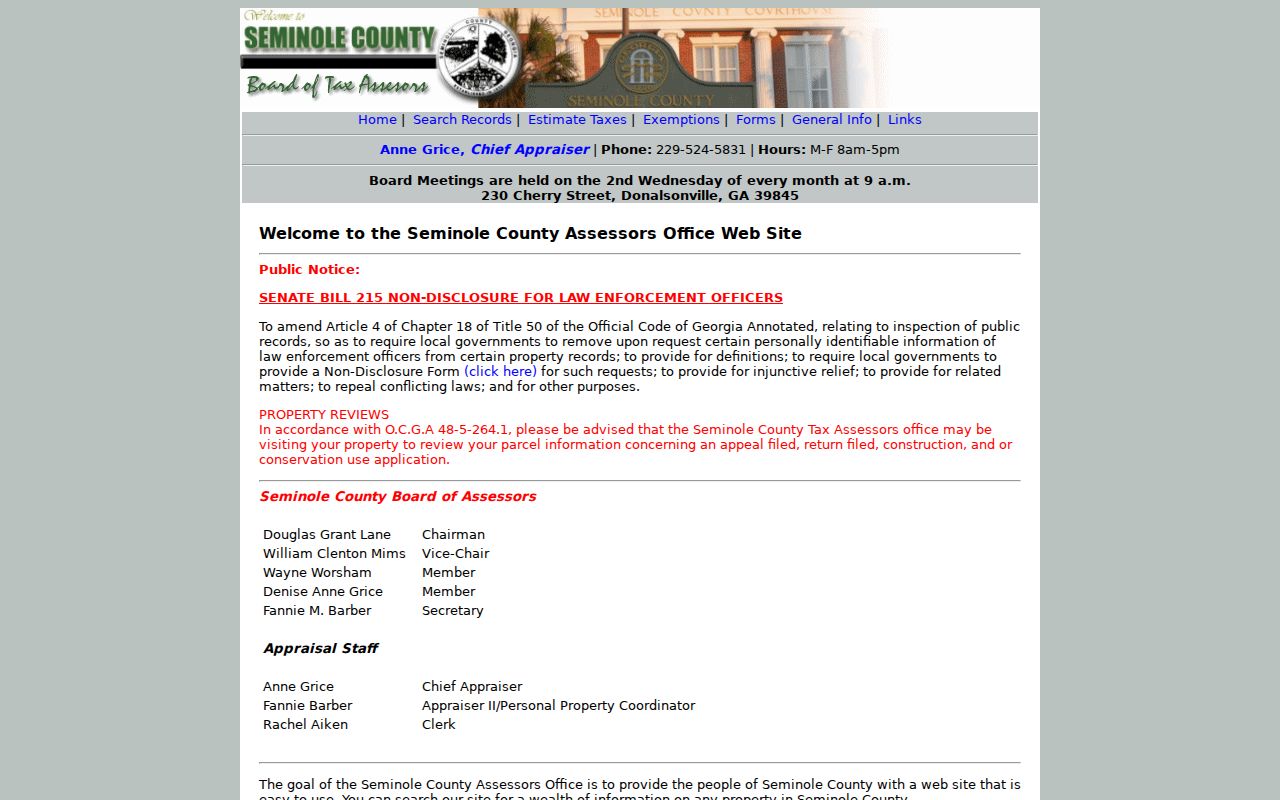
The qPublic link is the county's official assessor destination. It offers no publicly viewable parcel-level value card, so no claims are made here about its fields.
Define Seminole County Value Labels
Every value comparison depends on terms keeping their local meaning. These definitions follow the Seminole County sources and flag where the public record leaves a gap.
- Fair market value
- The assessor's estimate as of the annual valuation date.
- Assessed value
- Forty percent of fair market value in Seminole County's published tax explanation.
- Assessment ratio
- The percentage used to convert fair market value to assessed value.
- Sale or consideration price
- An amount tied to a particular recorded transfer, not an annual mass appraisal.
- Reassessment
- A new or updated determination placed on the assessment roll.
The county's qPublic card does not show the public whether land and improvement values are separated. Nor is it clear whether a value history appears, or whether the full estimate carries a market or appraised label. Do not assume those common fields exist on the Seminole card until you view it locally.
Seminole County Sale Value Evidence
A recorded sale amount tells you what one transaction reported. It does not tell you what the parcel is worth today. The GSCCCA real-property system offers deed and PT-61 search routes. Its Real Estate Index lists parties, recording details, property location, and book/page references. Seminole's assessor card does not display an exact sale price for public review. Use the deed or transfer record as the direct source instead.
Check that the transfer was an open-market sale before treating the amount as a comparison point. A quitclaim, family transfer, estate deed, or corrective instrument may not reflect a normal bargain. A transfer of only one interest distorts the picture too. Compare legal descriptions, not just addresses. One deed can cover several tracts. A parcel may also have changed shape after a split or combination.
Note: A last-sale amount can be useful context, but it is not an automatic current property value.
Exemptions Shift Seminole County Taxable Value
Seminole County's published tax materials describe standard homestead, elderly, disabled-veteran, and floating exemptions. An approved exemption lowers the taxable assessed figure. That is all it does. The assessor has not reduced the parcel's full fair market value by the same amount. Two similar parcels can carry nearly identical fair-market values. Yet they can show very different taxable values.
For a clean comparison, list fair market, assessed, exemption, and taxable amounts in separate columns. Confirm the assessment year for each. An exemption flag says nothing reliable about an owner's personal circumstances. Leave those conclusions out. Application mechanics and tax-bill details belong to the tax process. The Seminole County property tax records page covers those procedures without changing what each valuation number means.
Countywide Growth Is Not Parcel Value
Seminole County's 2024 millage notice traces a countywide trend, not a single parcel's worth. The gross digest climbed from $373,802,734 in 2019 to $460,082,347 in 2024. The net digest rose from $272,101,575 to $346,722,535 over the same span. Those figures describe the whole tax base. They cannot tell you what happened to one home, farm, or commercial tract. They also say nothing specific about a Donalsonville neighborhood or an Iron City parcel.
Millage belongs to taxation anyway. The notice proposed a 17.1110 net maintenance-and-operations rate and a 16.111 rollback rate. Those are levy numbers, not market prices. Read the digest for countywide scale and direction. Then open the individual parcel card for a Seminole County assessed value. The county publishes no official city-specific revaluation series or median. County totals should never be recast as a city trend.
January Anchors Seminole County Values
The annual valuation date explains why a public property value may differ from a later sale or a fast-changing market. Seminole County's official material places fair market value as of January 1. A deed recorded later in the year reports a different event on a different date. Comparing them without dates can make a normal difference look like an error.
Write down the tax year beside the assessor amount and the recording date beside the deed amount. If improvements, damage, a split, or a transfer occurred after the valuation date, ask the Assessor which year first reflects it. The county did not publish the precise qPublic refresh cycle or every reassessment trigger in the inspected pages. Do not guess at the timing.
Limits of Seminole County Assessed Value
An assessed value exists for one purpose: the property-tax system. It is not an offer, a guaranteed sale price, or a boundary finding. It is not a private appraisal either. A deed amount can differ simply because the dates and purposes differ. Legal notices are weaker still. Seminole's published FiFa-style sample lists parcel, owner roles, reference deed, description, address, and years due. It carries no market or assessed value at all.
Let the property records identify what the county has placed on the roll. For a transaction-specific opinion, turn to proper appraisal work and current market evidence. Questioning whether the assessor's number is right? Verify the actual card before comparing parcels. No inaccessible portal, countywide digest, or tax balance can stand in for that parcel-level detail.
Value is not price. A Seminole County assessed value serves taxation and does not state what the property would sell for or replace an appraisal.